Showing posts with label saint andrew. Show all posts

Tuesday, September 1, 2015

Making Your Prayers Go Viral


Making Your Prayers Go Viral 

Introduction 

While singing a prayer I've sung a hundred times, I noticed something interesting. And the implication of my observation is that, within the Communion of Saints, there is a way to multiply our prayers way beyond our own personal power. And this is something which Christians may have not fully taken advantage of. The secret to "making your prayer go viral" on the ears of God has been hidden in plain sight within the official liturgies of the Christian Church. 

Prayer in Numbers 

We ask other people to pray for us because Scripture teaches us that if one prayer is good, two prayers are better! 

We can see a biblical example of this principle when the Prophet Daniel asked his three friends to "seek mercies" from God that he could interpret the troubling dreams of the King of Babylon (Daniel 2:18-19). And the mystery was then revealed to Daniel in a dream. 

Why did Daniel not just pray on his own? If God wants to grant the prayer, just one person praying should be sufficient, right? And yet he asked three others to pray as well. St. Paul in his epistles also asks other christians to pray for him. And this clearly teaches us that when it comes to prayer, there is strength in numbers. 


Asking Others to Ask Others to Pray for us 


When we have a pressing need in our lives, we pray to God directly, of course. But we also reach out to friends and family to pray on our behalf as well. 

And there may have been times in which you asked a friend not just to pray for you, but also to ask their own circle of friends and family to pray for you as well. 

While we trust that God answers our prayers according to what we really need, Jesus also taught us to be persistent in prayer. He tells us to be as persistent as the widow who so bothers a judge that he eventually grants her justice merely to be rid of her. That’s how persistent we are to be. 
The implication is that there are things God would grant us, but only after we have prayed with great persistence and also multiplied our prayers through the help of others. 
That is why asking others to pray for us and even asking others to ask yet others is a reasonable and faithful practice. But what if we could take this to another level. To a higher level? 

Asking Saints to Ask Other Saints to Pray for us? 

Christians ask their family and friends to pray for them. Those of us in the Catholic and Orthodox communions also ask our family and friends who have fallen asleep to pray for us as well. I’ve posted some videos on this channel that defend the practice of saint intercession from the bible. 


Here's my controversial claim.  If we believe that the faithful departed can, by the power of God hear our requests that they pray for us, could we not ask them to ask others in Heaven to pray for us as well? Would this not be just the same thing as asking a friend to ask other friends? 

Here's why I'm thinking this is indeed a perfectly valid practice. I believe the implied request that a departed Saint ask other Saints to pray is actually contained in the official liturgies of the Church. 

Every Sunday, before the Divine Liturgy begins, I sing aloud the Third and Sixth Hours of Prayer for my congregation. And here's what I noticed is contained within the prayers of the Third Hour: 

O Birth-Giver of God, you are the true vine who has put for the Fruit of Life. We pray you, intercede, O Lady, with the Apostles and all the Saints, that our souls may receive mercy.
Θεοτόκε, σύ εί η άμπελος η αληθινή, η βλαστήσασα τόν καρπόν τής ζωής, σέ ικετεύομεν, πρέσβευε Δέσποινα, μετά τών Αποστόλων, καί πάντων τών Αγίων, ελεηθήναι τάς ψυχάς ημών. 

In the words of this prayer, we ask Mary to intercede for us. But we additionally ask Mary to intercede for us "with the Apostles and all the Saints." Note that this prayer does not include us directly asking "the Apostles and all the Saints" to pray for us. The implication here is that we are asking Mary, not just to pray for us but to enlist the Apostles and all the Saints to pray for us as well. 

And why not? If she can hear what we ask, we can ask her to pray for us. And we can ask her to ask others to pray for us. 

The way I have personally included this within my own prayer life is to ask certain Saints to ask those most like them to pray for me. And so, for instance, when I ask my namesake Saint Andrew to pray for me I say, “Saint Andrew, intercede for me with all your brother apostles that I receive mercy. 

I ask St. Irenaeus bishop of Lyon to pray for me every day. I made him a character in my time travel adventure novel In Saecula Saeculorum. In the course of writing that novel I came to  have a particular devotion to him and relationship with him. And so I daily say “Saint Irenaeus, pray for me with all your brother bishops that I may receive mercy. 

That's the idea. Now, keep in mind, asking others to pray for us is meaningless if we are not primarily praying for ourselves. My prayer time is overwhelmingly spent in direct prayer to God. I pray for my beloved dead. And I do ask them and certain Saints to pray for me. And now, in imitation of this prayer from the 3rd Hours I ask them to ask others. But that time is a fraction of the time I am directly in Communion with my Creator. 

And so, as we pray to our Father directly, and as we ask friends on earth and friends above to both pray for us and ask still more on our behalf, may our prayers multiply before our Loving God, who will grant us, according to His good will those things that we truly need.

Saturday, November 29, 2014

The Romanian Nativity Wheat Sprouting Tradition!


On St. Andrew's Feast Day (which began at sundown today [November 30] on the Church calendar), Romanians sprinkle wheat grains on tufts of cotton and water them. The successful sprouting of the grains during the days leading up to the Nativity is viewed as a portent of the year to come.

Yes, it borders a bit on the superstitious. But it's a delightful tradition!


Here are our plates for this year. We used Holy Water we brought back from a trip to Israel (not strictly necessary by, hey, we'll take all the help we can get). Between the plates is an icon of St. Andrew that I touched to his skull at Patras in Greece.

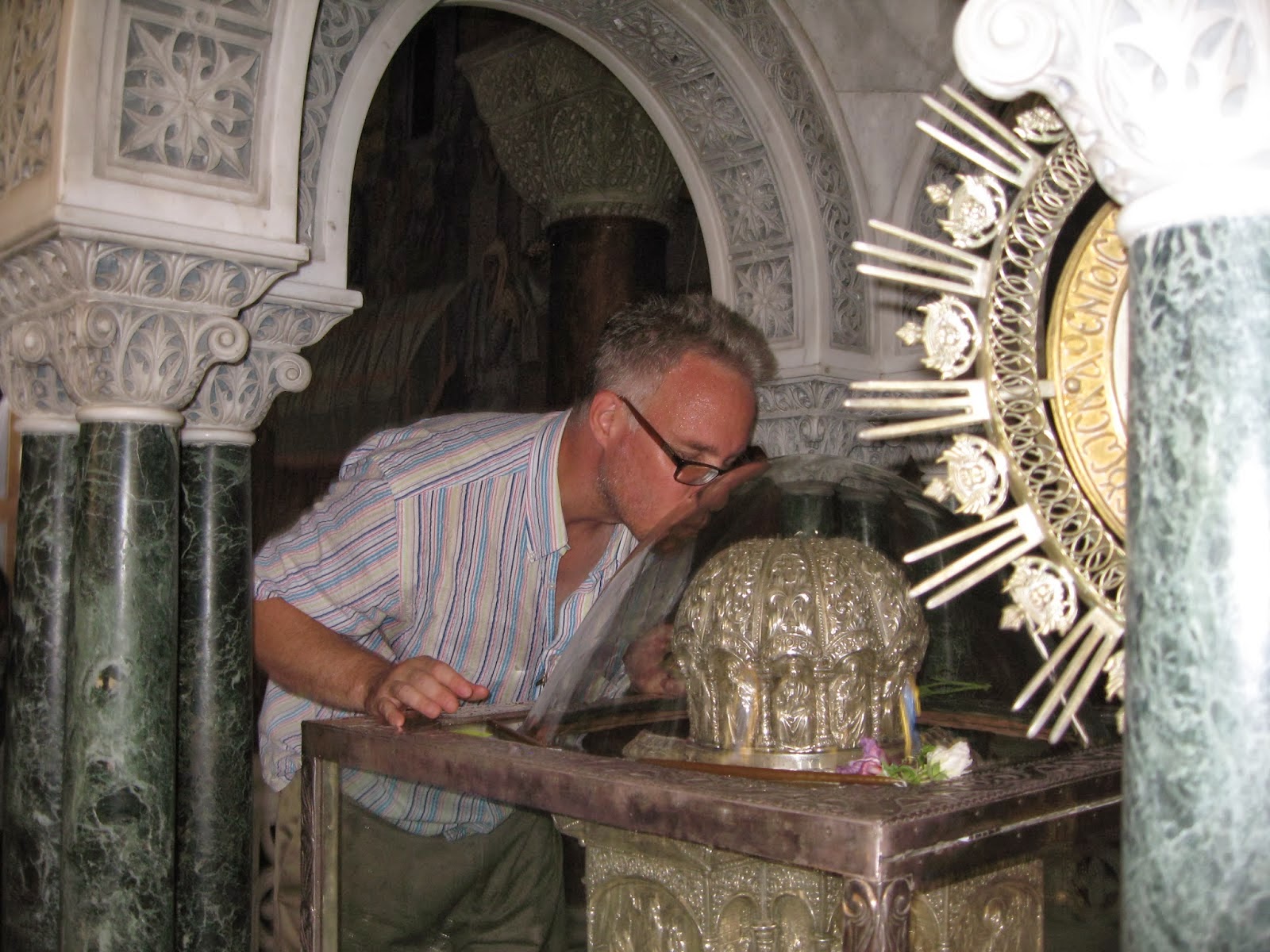
Here I am kissing and venerating his relics at the Cathedral of St. Andrew in Patras in 2011.

Pray for us, O Glorious Saint Andrew!


Bonus: Here's a video I made today about why Saint Andrew is so important to me and also my theory that Andrew was not his original name:


Saturday, November 30, 2013

Saint Andrew: a Man's Man of God

Today is November 30, the Feast of Saint Andrew on the Eastern Orthodox calendar. 

 I was baptized in the Lutheran Church on August 28, 1966 under the name Keith Andrew. My twin is Kevin Alan. My parents gave him as a middle name the name of our paternal grandfather. I got a random name starting with 'A' so we'd have the same initials.

As a child this fact annoyed me a bit. He had a name of the family. I had, well, something else. It would take some years, but I came to cherish that "something else."

I was chrismated Orthodox on December 14, 2003 under the name Andrew. I had come to embrace the fact that this accidental middle name starting with 'A' was that of one of the Twelve Apostles. After I met my wife, a Romanian-American, I further learned that Andrew is the Patron of Romania, owing to a belief that the Apostle had preached there during his travels. 

Furthermore, since Romanian doesn't have the 'TH' sound, non-linguistically trained friends and family there kept pronouncing my first name as either Keet or Kees. So we decided, I would just be Andrei in Romania. 

So I've gone from resenting the name just a little to now having it as my full Orthodox identity.

On this Feast of St. Andrew, I'll share some thoughts on the Saint and also show you the place in Greece where I had the honor of venerating my namesake's relics.

First off, I have read some modern commentators that downplay the possibility that St. Andrew ever was in Romania, pointing out that it is attested "only by one source."

I can tell you that there are plenty of things we teach as history that are attested only by one source from ancient times. Without a compelling reason to distrust a source, the best methodology is to accept the report as probable.

But in this case, it isn't even really true that it's just one source. 

One source is quite early (200's AD) and specific. St. Hippolytus (On the end of the world, Ch. 49.2):

Andrew preached to the Scythians and Thracians, and was crucified, suspended on an olive tree, at Patrae, a town of Achaia; and there too he was buried.

But Eusebius quotes Origen (roughly contemporary to Hippolytus) as saying that Andrew preached among the Scythians (Church History 3.1). So the belief that Andrew had travelled to that vicinity was quite old and known from more than one testimony.

It is significant that Hippolytus describes Andrew preaching to the Thracians. Thracia includes the area of modern day Bulgaria. Dacia is roughly modern day Romania. In that time the range of the Scythians stretched from the area of Dubrogea in modern-day Romania all the way past the north shore of the Black Sea in the Ukraine and Russia.

So the fact that he mentions the Thracians indicates that Andrew didn't go to the Scythians via the eastern shore of the Black Sea. And if he then continued to the Scythians, he of course traversed land in present-day Romania. Along the way he would have encountered Tomis, a city situated at modern-day Constanta. Tomis had a sizable Greek speaking population, to which Andrew would certainly have preached.

Me at the Cave of St. Andrew in Romania
In Romania there is a cave considered the home of Andrew while he lived in Romania. The historical probability that this site is connected with the real St. Andrew is minimal. Local legends had said Andrew lived in a cave while in Romania. In 1940, a lawyer named Ion Dinu reported a dream in which the location of the cave was told to him. A monastery quickly started at the spot. I had the privilege to venerate the Saint at the spot. While I am certain of Andrew's passage through Romania, I venerated the cave as if it were an icon of Andrew's presence in Romania. My veneration of the Saint and his ministry in Romania does not require intellectual credence of that specific location.

The end of Hippolytus' account describes St. Andrew's martyrdom back in Greece, the city of Patrae in Achaia. In 1461, the Byzantine despot Thomas Palaiologos gave the head of St. Andrew to the Pope. But in 1964, as a goodwill gesture to the Orthodos, Pope Paul VI ordered the skull and all other relics of St. Andrew in Vatican custody to be returned to Patras. 


It was at the beautiful church there that I got the opportunity to venerate the relics of my namesake. Here I am in the summer of 2011 at the Basilica of St. Andrew in Patras.


A final thought about St. Andrew. I have the suspicion that Andrew is not really the name his father Jonah gave him. First off, why would this Palestinian Jew named Jonah name one son with a nice Hebrew name like Simon and then name another with a Greek name? Andrew is derived from the Greek Andreia (ἀνδρεία), manhood, valour.  So it means something like "manly one."
Wood from St. Andrew's Cross
 

I propose that Andrew (Ἀνδρέας) was a nickname given tothis disciple by Jesus, just as he nicknamed Andrew's brother Simon as Cephas (Κηφας)/Petros/The Rock (John 1:42). He also nicknamed the James and John, sons of Zebedee as Boanerges (Βοανηργες), Sons of Thunder (Mark 3:17). 

Jesus seems to have given nicknames to some of the disciples based on personal qualities they were exhibiting. Andrew exhibited a perceived manliness (culturally conditioned to his time) in his courage to introduce people to Jesus. It is Andrew who introduces his brother Simon to Jesus. (John 1:41-42). It is Andrew who introduces the boy with the loaves and fishes to Jesus (John 6:8). It is Andrew, with Phillip, who introduces Jesus to several Greeks who were interesting in Jesus' message (John 12:22).

So what was Andrew's real name? It's irrecoverable. And it ultimately doesn't matter. I'm proud to share this name with him. Pray for me, Saint Andrew.

The Kontakion of St. Andrew, November 30

Let us praise Andrew, the herald of God, the namesake of courage, the first-called of the Savior’s disciples and the brother of Peter. As he once called to his brother, he now cries out to us: “Come, for we have found the One whom the world desires!”


AddThis