Showing posts with label romania. Show all posts

Tuesday, August 30, 2016

Living with—and Writing through—Regret


A Lifetime of Regrets

While visiting my wife's native Romania one summer, I learned that there had been an anti-communist insurgency there back in the 50's. It was eventually crushed in the early 60's.

I began to imagine a family in Transylvania who fought as anti-communist freedom fighters. I imagined that this family's motivation was largely in defense of the Church that the communists were suppressing. 

And in particular I found myself dwelling on the regret and disappointment such people must have experienced when their hard-fought effort came to nothing and they were forced to either flee the country or form a life within the communist system.

https://www.amazon.com/gp/product/0984343202?creativeASIN=0984343202&linkCode=w00&linkId=TO6L3PPQYTKDC5LN&ref_=as_sl_pc_tf_til&tag=keitmassintea-20

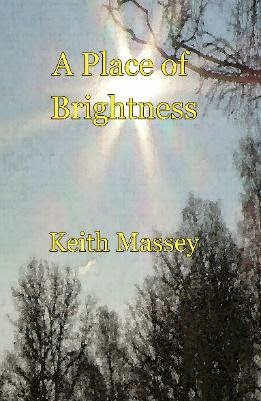
And so it was that I began writing the novel A Place of Brightness. It shares the saga of such a family of freedom fighters as they experience the end of the rebellion. It continues to a second generation who must unexpectedly take up the torch and face their family's enemies.

In the very first chapter, I describe how a brother and sister team have resolved that their current operation against the communists would have to be their last. They dare to share with each other dreams of the life they will fade into as they now set their rebellion aside.

But things don't go according to plan on that final mission and what follows are lives deeply and tragically wounded by the regret of what never came to pass.


What Brought Me There

Like you, so many things I had once perhaps imagined my life could include and would mean—just didn't happen as I planned.

Lofty dreams of my youth never materialized. 

More reasonable dreams of my young adulthood came true in only mixed measure.

Safer plans in my full adulthood evolved into a comfortable life. 

And then my world was turned upside down.

You see, I had a PhD in Biblical Hebrew, with a minor in Arabic. That was a safe plan, since it had followed accepting a scholarship. And I loved the study.

But then, on the evening of Tuesday, September 11th, 2001, I saw appeals on the news for people with expertise in Arabic to submit resumes to the intelligence agencies in response to what had happened.

Quick version. Submitted. Accepted. Suddenly I was an Intelligence Officer at the National Security Agency.

What followed was a whirlwind of adventure and emotion. I would serve in Iraq, for which I was awarded the Global War on Terrorism Civilian Service Medal.  I would serve in the Office of Counter Terrorism, helping to foil plots against our nation.

I served at the NSA for four years, longer than the US was in WWII. I came to a point where I was ready to move on—and to a quieter life. 

As I resigned my position and became a mild-mannered Latin teacher, I needed a way to process all that I had been through.


A Place of Brightness 

I wrote my novel for many reasons. As a boy growing up in Wisconsin, I never imagined I would ever stand in a war zone. Some of the more intense battle scenes of the novel allowed me to process the chaos and insanity of it all. 

As I look back on my life, I certainly have some regrets. The experience of going to war and working in the Top Secret world of espionage had a toll on me. A part of me wonders, with understandable regret, what my life would be had I not gone down that path.

At the same time, I would not change anything were I given the chance to do it all over. I am what I am today because of the choices I made.

My novel is primarily a story of family and faith. I come from a close family and the bonds the characters in A Place of Brightness share are real. They are practicing Christians because I would dishonor myself to write them any other way. 

But a most important matter explored in the novel is the tremendous burden the brother and sister will experience as the dreams of a future life which they hoped for on that final night—are crushed.

What do you do when everything you ever dreamed your life would mean is suddenly gone?

As you will learn in the novel, the answer is—you pick up a new dream and you move forward—in faith.

Saturday, November 29, 2014

The Romanian Nativity Wheat Sprouting Tradition!


On St. Andrew's Feast Day (which began at sundown today [November 30] on the Church calendar), Romanians sprinkle wheat grains on tufts of cotton and water them. The successful sprouting of the grains during the days leading up to the Nativity is viewed as a portent of the year to come.

Yes, it borders a bit on the superstitious. But it's a delightful tradition!


Here are our plates for this year. We used Holy Water we brought back from a trip to Israel (not strictly necessary by, hey, we'll take all the help we can get). Between the plates is an icon of St. Andrew that I touched to his skull at Patras in Greece.

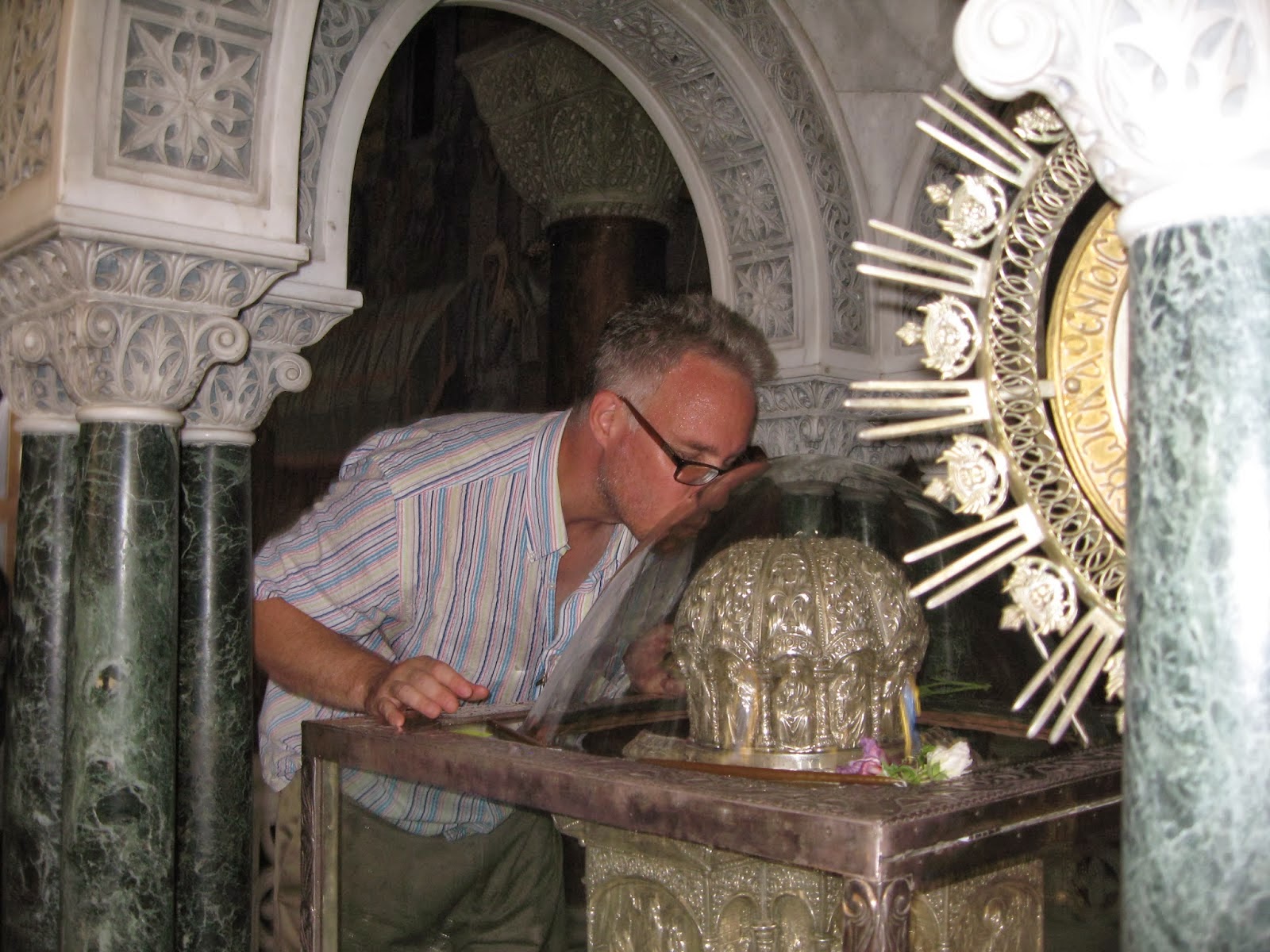
Here I am kissing and venerating his relics at the Cathedral of St. Andrew in Patras in 2011.

Pray for us, O Glorious Saint Andrew!


Bonus: Here's a video I made today about why Saint Andrew is so important to me and also my theory that Andrew was not his original name:


Sunday, August 17, 2014

In Defense of the Cathedral for the Salvation of the Romanian People (Catedrala Mântuirii Neamului Românesc)

The current Romanian national cathedral is a structure which was built in the 17th century. Since that time, Romania has grown to be the second largest Orthodox national church, after Russia. I've been in the national cathedral. The Lutheran church where I grew up in Madison, Wisconsin is bigger, and actually more beautiful, especially in terms of internal lighting.

And my point is simple. The Romanian Orthodox Church needs, nay, deserves a new cathedral which matches her size and significance within world Orthodoxy.

I am a convert to the Eastern Orthodox Church of ten years. After I became Orthodox I met the Romanian-American woman I then married. We are school teachers and have spent most of our summer vacation in Romania in that time. I have learned to speak competent Romanian. I know and love Romania. 

Artist Depiction of the Cathedral under Construction
The Romanian Orthodox Church is currently building a new national cathedral. It will be called the "Cathedral for the Salvation of the Romanian People" (Catedrala Mântuirii Neamului Românesc). 

It is everything they deserve in terms of the grandeur of their Church. But, not surprisingly, there has been criticism of the project from many quarters. In this post, I will address the issues and explain why the new cathedral is so worthy of support.


The Cathedral for the Salvation of the Romanian People (Catedrala Mântuirii Neamului Românesc)

One of the common criticisms you will hear is that, the Romanians are building a huge new cathedral while people are in need. Why don't we instead spend all that money on schools, hospitals, and other support for the poor?

This immediately reminds me a quote from Gilbert Chesterton:

"Those thinkers who cannot believe in any gods often assert that the love of humanity would be in itself sufficient for them; and so, perhaps, it would, if they had it."

The point is, only the Church is criticized for spending any money not on the poor. Where are the soup kitchens that the Atheists run? (The new cathedral, by the way, will run a soup kitchen for a thousand.) Some businessman builds a new stadium for a soccer team and no one protests it telling him he should instead have built a hospital. For that matter, count up the free clinics built and operated by the Orthodox Church in Romania. They were under no legal obligation to build so much as one. And yet they built many. And the moment they decide to build a new cathedral, they are attacked for not building more hospitals? 

If you don't like the new cathedral, put your so-called ideals where they really belong. Don't blame the Church for not building one more hospital. Build one yourself. You'll find it enormously complicated. And if you actually do try to build one, you'll emerge with respect for the Church for her efforts over the centuries. 

I suspect, however, that the critics won't really try. Building hospitals is hard. Criticizing others for not building hospitals is easy.

Another criticism I have heard in Romania regards the location of the new cathedral. It is right next to the Palace of the Parliament, a monstrosity built by Ceausescu for an estimated 5.7 billion US dollars. And so, the criticism is that the new cathedral looks, next to it, like just one more building that drew enormous expense off the people.

Let's address the issue of location. If you've ever been in Bucharest, you'll notice that the Ikea store that was built after Communism is not in the downtown.  It's on the way to the airport, in an area that was completely undeveloped when I first started coming to Romania.

Why is the Ikea not downtown? For the simple fact that there is absolutely no place downtown where you could possibly have fit it in!

And, guess what? There is nowhere downtown where you also could have put a cathedral worthy of the Romanian Church. 

Imagine if they had decided to build the cathedral in that undeveloped area on the way to the airport. Then there would have been a public outcry saying, "They're building the new cathedral too far away from the city!"

Yeah, that's right. No matter what they did someone was going to criticize it.

Now, it just so happens that the only place anywhere remotely close to the city center with undeveloped land capable of housing a project as significant as the cathedral the Romanian Orthodox Church deserves is...next to the Palace of the Parliament. Building it there is not just practical. It's a necessity.

As for the cathedral being built at the expense of the people, the government donated land that was not previously being used for the project. They did so knowing that this project would eventually generate money for the nation in the following way.

Romania is growing yearly in tourism potential. When completed, the new cathedral will be a major attraction for visitors to Bucharest. Admission to the cathedral will be free. But if the Church sells candles, icons, and other items, the cathedral will end up paying for itself in the long run.

And there's nothing wrong with that.

So, in the final analysis, I could not more enthusiastically support the current construction of the Cathedral for the Salvation of the Romanian People (Catedrala Mântuirii Neamului Românesc). Until  the day of its consecration (estimated sometime in 2016), I will be donating all the proceeds from my novel A Place of Brightness to that building project. 

http://www.linguasacrapublishing.com/masseyexcerptbrightness.html
This novel is set almost entirely in Romania and follows the story of a faithful Orthodox family struggling against Communism in the 1960's and then pulled into international intrigue in the early 2000's as they must once again fight against an atheistic tyranny they thought was long defeated. 

Please note, do not buy this novel if you do not want to support the new cathedral project.


If you would like to donate directly to the new cathedral, please visit their website.


Thursday, July 24, 2014

Let's Visit Mănăstirea Plumbuita - the "Lead-Sealed Monastery" in Bucharest

Our Wedding at Plumbuita

Mănăstirea Plumbuita means "The Lead-Sealed Monastery." It's a place near and dear to my heart, because it's where my wife and I were married back in 2005. And, in my mind, it was the setting of key scenes of my novel A Place of Brightness.

Mănăstirea Plumbuita is situated in the north-east quarter of Bucharest, Romania, on a peninsula within Lacul Plumbuita (Plumbuita Lake). It's
Aerial view of the monastery
a monastery that has been in continuous operation since the year 1560. It's called "Lead-sealed" (Plumbuita) because in the very early days, the church on the site was roofed with lead tiles (since then demolished and rebuilt). No current building on the premises has lead tiles. But the name stuck. For over 400 years. 

http://www.linguasacrapublishing.com/masseyexcerptbrightness.html


In my novel, several key episodes take place at a monastery called Mănăstirea
Sfânta Treime. This means "Holy Trinity Monastery." But Mănăstirea Plumbuita was the place these scenes actually happened in my mind's eye. 


To the left you see the current church, built in the 18th century, over the spot of an earlier edifice. Early in my novel, on old monk is described as praying there. 


The church is a place with dark, hand-painted walls, likely darker from hundreds of years of incense and candle residue. To the right is what the inside looks like. 

In my novel, I describe how the monastery is surrounded by twenty foot brick walls, with massive wooden doors for entrance. To the left is what I was actually describing, the gate below the bell tower of Plumbuita, all of which was built in 1802.


The monastery operates a free clinic and pharmacy for low-income families. Please visit their main website (it's in Romanian but Google translate will do a good enough job) to learn more and donate to their worthy ministry.


Saturday, November 30, 2013

Saint Andrew: a Man's Man of God

Today is November 30, the Feast of Saint Andrew on the Eastern Orthodox calendar. 

 I was baptized in the Lutheran Church on August 28, 1966 under the name Keith Andrew. My twin is Kevin Alan. My parents gave him as a middle name the name of our paternal grandfather. I got a random name starting with 'A' so we'd have the same initials.

As a child this fact annoyed me a bit. He had a name of the family. I had, well, something else. It would take some years, but I came to cherish that "something else."

I was chrismated Orthodox on December 14, 2003 under the name Andrew. I had come to embrace the fact that this accidental middle name starting with 'A' was that of one of the Twelve Apostles. After I met my wife, a Romanian-American, I further learned that Andrew is the Patron of Romania, owing to a belief that the Apostle had preached there during his travels. 

Furthermore, since Romanian doesn't have the 'TH' sound, non-linguistically trained friends and family there kept pronouncing my first name as either Keet or Kees. So we decided, I would just be Andrei in Romania. 

So I've gone from resenting the name just a little to now having it as my full Orthodox identity.

On this Feast of St. Andrew, I'll share some thoughts on the Saint and also show you the place in Greece where I had the honor of venerating my namesake's relics.

First off, I have read some modern commentators that downplay the possibility that St. Andrew ever was in Romania, pointing out that it is attested "only by one source."

I can tell you that there are plenty of things we teach as history that are attested only by one source from ancient times. Without a compelling reason to distrust a source, the best methodology is to accept the report as probable.

But in this case, it isn't even really true that it's just one source. 

One source is quite early (200's AD) and specific. St. Hippolytus (On the end of the world, Ch. 49.2):

Andrew preached to the Scythians and Thracians, and was crucified, suspended on an olive tree, at Patrae, a town of Achaia; and there too he was buried.

But Eusebius quotes Origen (roughly contemporary to Hippolytus) as saying that Andrew preached among the Scythians (Church History 3.1). So the belief that Andrew had travelled to that vicinity was quite old and known from more than one testimony.

It is significant that Hippolytus describes Andrew preaching to the Thracians. Thracia includes the area of modern day Bulgaria. Dacia is roughly modern day Romania. In that time the range of the Scythians stretched from the area of Dubrogea in modern-day Romania all the way past the north shore of the Black Sea in the Ukraine and Russia.

So the fact that he mentions the Thracians indicates that Andrew didn't go to the Scythians via the eastern shore of the Black Sea. And if he then continued to the Scythians, he of course traversed land in present-day Romania. Along the way he would have encountered Tomis, a city situated at modern-day Constanta. Tomis had a sizable Greek speaking population, to which Andrew would certainly have preached.

Me at the Cave of St. Andrew in Romania
In Romania there is a cave considered the home of Andrew while he lived in Romania. The historical probability that this site is connected with the real St. Andrew is minimal. Local legends had said Andrew lived in a cave while in Romania. In 1940, a lawyer named Ion Dinu reported a dream in which the location of the cave was told to him. A monastery quickly started at the spot. I had the privilege to venerate the Saint at the spot. While I am certain of Andrew's passage through Romania, I venerated the cave as if it were an icon of Andrew's presence in Romania. My veneration of the Saint and his ministry in Romania does not require intellectual credence of that specific location.

The end of Hippolytus' account describes St. Andrew's martyrdom back in Greece, the city of Patrae in Achaia. In 1461, the Byzantine despot Thomas Palaiologos gave the head of St. Andrew to the Pope. But in 1964, as a goodwill gesture to the Orthodos, Pope Paul VI ordered the skull and all other relics of St. Andrew in Vatican custody to be returned to Patras. 


It was at the beautiful church there that I got the opportunity to venerate the relics of my namesake. Here I am in the summer of 2011 at the Basilica of St. Andrew in Patras.


A final thought about St. Andrew. I have the suspicion that Andrew is not really the name his father Jonah gave him. First off, why would this Palestinian Jew named Jonah name one son with a nice Hebrew name like Simon and then name another with a Greek name? Andrew is derived from the Greek Andreia (ἀνδρεία), manhood, valour.  So it means something like "manly one."
Wood from St. Andrew's Cross
 

I propose that Andrew (Ἀνδρέας) was a nickname given tothis disciple by Jesus, just as he nicknamed Andrew's brother Simon as Cephas (Κηφας)/Petros/The Rock (John 1:42). He also nicknamed the James and John, sons of Zebedee as Boanerges (Βοανηργες), Sons of Thunder (Mark 3:17). 

Jesus seems to have given nicknames to some of the disciples based on personal qualities they were exhibiting. Andrew exhibited a perceived manliness (culturally conditioned to his time) in his courage to introduce people to Jesus. It is Andrew who introduces his brother Simon to Jesus. (John 1:41-42). It is Andrew who introduces the boy with the loaves and fishes to Jesus (John 6:8). It is Andrew, with Phillip, who introduces Jesus to several Greeks who were interesting in Jesus' message (John 12:22).

So what was Andrew's real name? It's irrecoverable. And it ultimately doesn't matter. I'm proud to share this name with him. Pray for me, Saint Andrew.

The Kontakion of St. Andrew, November 30

Let us praise Andrew, the herald of God, the namesake of courage, the first-called of the Savior’s disciples and the brother of Peter. As he once called to his brother, he now cries out to us: “Come, for we have found the One whom the world desires!”


Friday, August 17, 2012

Musings on the Sign of the Cross

Riding the tram this morning from our apartment here in Bucharest to the National Library (my quiet, clean, smoke-free refuge to get some work done), one can't help but see that people in this majority Orthodox country still make the Sign of the Cross when they see a Church. It's a seemly practice, one which I added to my inventory when I was chrismated Orthodox years back. 

When Should You Do It?

A non-Orthodox observer would have quite a few questions while watching the practice. First off, there is the phenomenon of people crossing themselves when there is no apparent Church in sight. I've come to understand that some people are aware of a Church in the near vicinity, but which is not, in fact, visible from this spot on the street. And this raises the question of whether you should cross yourself when you see other people do it.

And this is a bigger question than just the possible presence of a Church down that dark alley. I see this all the time during Liturgy as well. Almost everyone will cross themselves when the Liturgy contains the words "Father, Son and Holy Spirit." That's a moment where, if you're going to do it, you really ought to cross yourself. But others will cross themselves at any mention of the Virgin Mary. Or even at every Lord, Have Mercy. And if one person crosses themselves, there can be a cascade effect, as other people must wonder, "Oh no, this guy knows we're supposed to cross ourselves! I'd better do so as well." I've at times gone to scratch an itch on my forehead and seen people near me make the sign of the cross.

How Many Times is Enough?

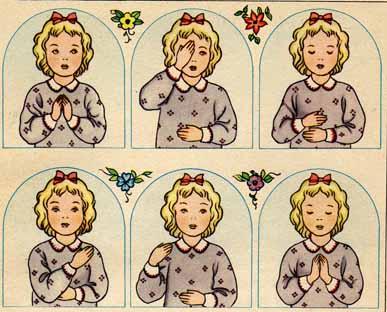
 I cross myself once when I see a Church. Some people cross themselves twice. (I guess because if once is good, twice is better.) Most people I observe do it three times, I'm sure for each person of the Trinity. But yet, while you make the sign of the cross, you invoke the Three Persons of the Trinity. Theoretically, once you've multiplied to three, you wonder why it doesn't then jump to nine, you know, three times for each person of the Trinity. 

It should also be pointed out that, while the Sign of the Cross includes invocation of the Trinity, the movement itself is not Trinitarian. It is, true to advertising, the shape of a Cross. I've seen people assign the forehead to the Father and then give the Son and the Holy Spirit each a shoulder, as if really trying to fit a square inside a triangle.

Back to the matter of invisible Churches. If some person is aware that there's a Church on the other side of the block, but you can't see it from here, that raises the question of just how far away a Church has to be before people agree you don't have to acknowledge it. I mean, there just has to be some sort of statute of limitations on these things. In a city like Bucharest, there really is a Church on every block.

And in the end, why are we crossing ourselves as we pass Churches anyway? I fear that on a popular level some of this comes from a sense that if we don't do this, God will be offended. It's an old sentiment, the very thought that made the Athenians erect an altar to the "Unknown God." 

We should cross ourselves when we see Churches because it is an opportunity to worship God and show proper respect for his Temples. 

And so, I have a simple rule I follow on public transportation or while driving. I cross myself when I see a Church. If I'm packed into a bus and pointed one way and I see other people cross myself, I don't do it just because apparently it's the time we're supposed to cross ourselves. And I don't believe God is mad at me. Nor do I risk hurting myself and others by letting go of the handrail to perform the practice (which I've seen done). 

What Counts as a Church?


Along my route to the area of the Bucharest University, we pass a large Armenian Church. And I've noticed that many fewer people cross themselves there than as we pass a Romanian Church. I guess they are aware we are not in Communion with the Armenians (or other Orientals, owing to their non-acceptance of some matters resolved at the later Ecumenical Councils).

I personally cross myself when I can be reasonably sure that there's at least a cross inside that place of worship. So cross myself at an Armenian or Catholic Church? Of course! And I've visited enough Protestant Churches to know which ones are not Iconoclastic and thus have something inside them that makes them worthy of the title "Temple of God." 


[This is the image of Jesus I saw every Sunday of my formative years at Trinity Lutheran Church in Madison, WI. I'd kiss this icon, except it's twenty feet up the front wall.]

And I'm not going to lie. There are some denominations, in front of whose temples,  I don't cross myself. I guess in the end, my criterion will finally be, I'll cross myself in front of any Trinitarian Christian house of worship that uses the word Church. St. Paul didn't ever write an epistle to the "Praise Center" at Corinth.

Right to Left, Left to Right?

I might as well wade into the final controversies. Catholics and Orthodox famously cross themselves in different directions. A common notion you'll hear among Orthodox is that the Catholics stupidly changed their direction because they were trying to imitate the movement of the priest's blessing from their perspective.

Looking at the matter scientifically, I think it's much more probable that the Orthodox changed their direction.  I changed the direction of how I cross myself when I became Orthodox (and I crossed myself even as a Lutheran). I now cross myself Eastern Style. But here's why I believe the Western Style is more original.

First off, we need to acknowledge that the oldest references to making the Sign of the Cross describe just making a Cross motion on the forehead, presumably with just one of your fingers. (2nd Century, Tertullian, De cor. Mil., iii.) So there isn't even an original practice handed down from the Apostles. This was a practice that developed over time. And if it had developed differently in different places, it wouldn't make anyone right or wrong in how they do it.

In terms of Population Study, we've got data points on how to make the Sign of the Cross in the West, East, and further East and South. Copts down in Egypt, as well as other Orientals not in Communion with the Orthodox, cross themselves Left-Right, just like Western Style. They do so under no influence from the West. Then you've got this massive body of Eastern Christians, with contiguous borders, all crossing themselves Right-Left. The other thing to keep in mind is that in the time these practices were developing, the vast majority of Christians were in that Eastern population group. 

A mutation (a change) is always more likely to emerge inside a larger population group. That's the reason small and isolated populations preserve older forms of language than large and connected population groups. So evidently, after the practice of making the full-body Sign of the Cross had developed, a change in orientation (or occidentation in this case) popped up in the East. In fact, it's not impossible that people started crossing themselves Right-Left in order to imitate the movement of the priest from his perspective. This innovation quite naturally spread only within the large and connected communities making up the Eastern Church. This innovation did not spread into groups which, at the time, were smaller and more isolated, such as the Coptic and Roman Churches. And the fact that groups, separated geographically by the larger group, share a common practice is actually sufficient proof that they preserved an older form.

In the final analysis, it doesn't matter. I will say, however, that the way in which I have heard some Orthodox describe their claimed rectitude on this matter is unkind, unseemly, and, ultimately, unnecessary.  And if it turns out the East were the innovators, such talk is deeply embarrassing. 

We know we preserve the original practice on crucial matters, not least of which are the words of the Niceno-Constantinopolitan Creed and the age for the reception of the Sacraments. Let's continue talking about that. Even if it weren't possible that the Eastern Church changed the original practice, we should not be teaching children that the "Catholics are doing it wrong" when this is a matter on which Christian practice does not need to be uniform.

Tuesday, August 7, 2012

The Least of My Brethren

I've expressed my frustration at times with a basic lack of civility in Romania, at least in Bucharest. It isn't, for instance, uncommon here to see someone take a long final drag off a cigarette, throw it on the ground, step on the bus, doors close behind her, and then exhale. It baffles me every time I see it. I wish I could say it was rare. It's not. I saw it yesterday. And until Romanians themselves stand up en masse and claim for themselves a country not ruled by thugs, these things will not change. 

But today I twice saw acts of Charity that brought tears to my eyes.

I was in a pedestrian crossing beneath a major fare. And old lady was struggling with a heavy cart. One step after one step she was struggling up several dozen more. I began walking toward her to help. I've so sadly seen old ladies in this circumstance ignored. Not today. Two people appeared, both offering to carry her cart up for her. A woman carried it up and waited for her until she emerged at the surface.

That alone made me feel better about the state of humanity.

Today we hit 42 Celsius in Bucharest. That's 107 Fahrenheit. That's hot.

I'm standing at a Tram stop. There's a derelict resting in the shade of a tree. They're everywhere in Bucharest, I'm not going to lie. He's holding an empty glass. 

I see an elegantly dressed business woman. She's taking a drink off a bottle of water she's just bought at a nearby vendor. She walks over and fills the derelict's glass from her bottle. 

He drinks the water and slurs what I barely understand as a thank you.

Both of these people served Christ today. They served Him in the person of the Least of His Brethren.

AddThis